REVIEW · SARAJEVO CANTON
Sarajevo Old Town: Bosnian Coffee, Baklava & Panoramic Views
Sarajevo reveals its character one street, mosque, market, and coffee cup at a time. This walk links the city’s Austro-Hungarian, Ottoman, religious, Olympic, and wartime stories, then finishes above the rooftops with a panoramic view of Sarajevo.
I like the stop for traditional Bosnian coffee and sweets, because it turns a history walk into a local custom rather than a march between monuments. I also like the chance to see Kazandžiluk, the copper-workers’ street, and try the craft yourself. The main consideration is the amount of walking on uneven streets, packed into anywhere from 150 minutes to three hours.
- A 500-year-old copper tradition: Visit Kazandžiluk and try copper crafting.
- Coffee served the Bosnian way: Pause at a local café for a 20-minute tasting.
- The city’s major faiths in one walk: See Orthodox, Catholic, Muslim, and Jewish cultural markers around central Sarajevo.
- World-changing history: Learn about the 1914 assassination at Latin Bridge.
- A strong finish: End near Sebilj after a scenic stop with a broad view over the city.
- Local guides with personal insight: Guides may include Dijana, Daniella, or Amela, depending on the booking.
From the Eternal Flame into Sarajevo’s many layers
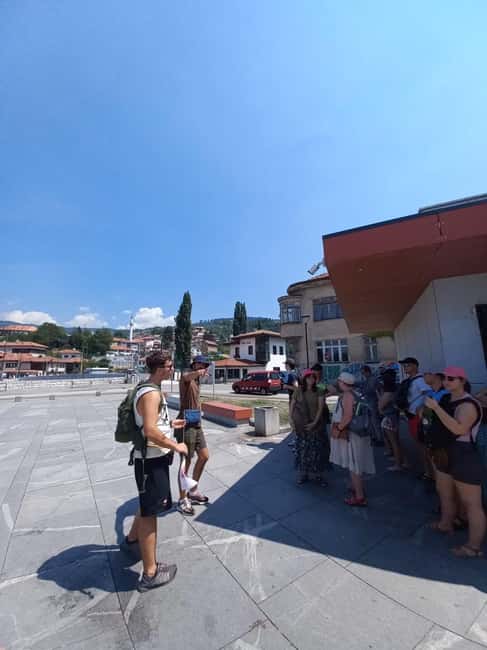
The tour begins at the Eternal Flame, Sarajevo’s daily meeting point for public memory and city life. Look for a guide in a Sarajevo Experiences T-shirt or holding a Sarajevo Experiences umbrella. The standard departure is at 10 a.m., while private bookings can include hotel pickup or pickup at an agreed address.
The opening walk introduces Sarajevo as a meeting place of cultures. You are not just checking off monuments. You are moving between streets shaped by different empires, faiths, and political eras. That makes a local guide especially useful here, since the meaning of each building is often tied to what came before it.
The Eternal Flame itself is a fitting start. It connects the modern city to wartime remembrance, while the surrounding streets quickly shift into the grand civic center. Wear shoes you can walk in for several hours, and dress for the forecast. Sarajevo’s weather can change the feel of the walk, especially during the open-air sections.
Market Hall, cathedrals, and the Meeting of Cultures
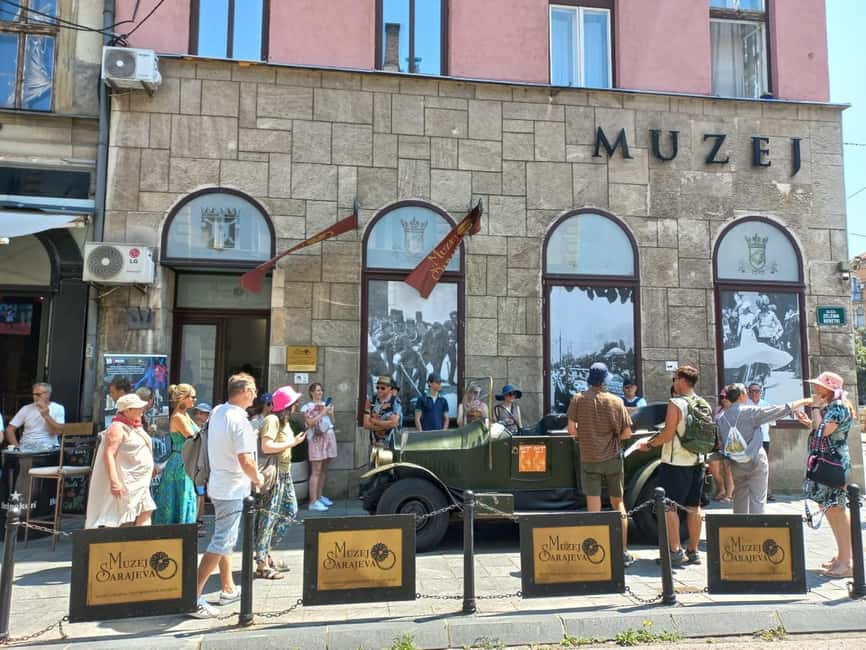
The City Market Hall is one of the first major stops. Its purpose is practical, but it also helps you see the relationship between Sarajevo’s everyday life and its formal architecture. A photo stop here takes little time, yet the guide’s explanation can help place the market within the city’s wider story.
Next come the Cathedral Church of the Nativity of the Theotokos and the Sacred Heart Cathedral. These two religious buildings help explain Sarajevo’s layered identity. You will hear about the city’s Orthodox and Catholic communities, and how several religious traditions exist within a compact central area.
The Sarajevo Meeting of Cultures marker is one of the walk’s simplest but most useful points. It marks the shift between the Austro-Hungarian part of town and the older Ottoman quarter. Stand here for a moment and you can see why Sarajevo feels so different from one block to the next.
I like this part because the change is visible, not just something a guide describes. The architecture, street pattern, and mood alter as you continue east. It also gives you a clear mental map for exploring on your own later.
More Coffee Tours in the world:
- Hanoi Coffee Experience: 6 Brews, 9 Recipes & 3 Liquor Tastings
★ 5.0 · 2,945 reviews - Medellin: Coffee Tour with Transport, Snacks and Tastings
★ 4.7 · 1,357 reviews - Istanbul: Turkish Coffee Making and Fortune Telling Workshop
★ 4.9 · 1,308 reviews
Latin Bridge and the event that changed the world
At Latin Bridge, the guide explains the assassination of Archduke Franz Ferdinand and Sophie. The event took place in Sarajevo in 1914 and helped set off the chain of events that led to World War I.
This stop can be brief or detailed depending on the pace of the group. The value is not just knowing the date. You get a sense of how one location in central Sarajevo became tied to a global turning point.
I recommend listening closely here, even if you already know the basic story. A local guide can explain the event in relation to the surrounding streets and the city’s political setting. It is also a good point to ask questions, since the tour welcomes questions about history, culture, architecture, customs, and food.
Ottoman Sarajevo, from the Emperor’s Mosque to Gazi Husrev-beg
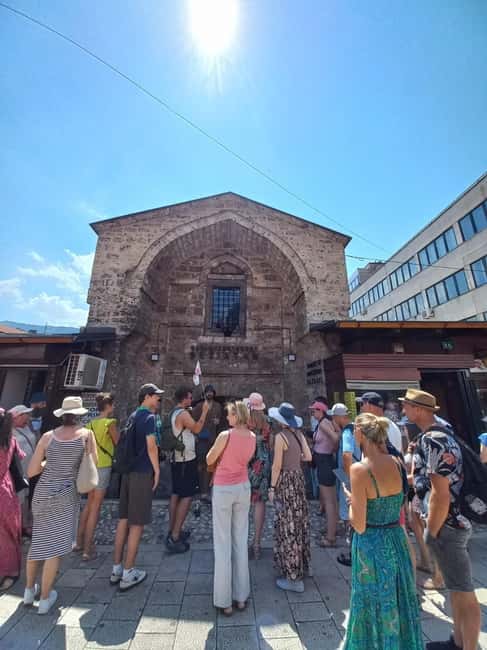
The route then moves into the Ottoman heart of Sarajevo. The Emperor’s Mosque introduces one of the city’s early Islamic landmarks, while Gazi Husrev-beg Mosque shows the importance of Ottoman urban planning, worship, and public life.
You will also visit Morića Han, a historic inn connected with the old trading quarter. Places like this help explain how Sarajevo functioned as a stop along regional trade routes. Rather than viewing the old town as a collection of pretty façades, you begin to see it as a working city built around travelers, merchants, worshippers, craftsmen, and coffee drinkers.
The Gazi Husrev-beg area can be busy, so stay close to your guide during the walk. The route uses public streets and squares rather than a sealed museum circuit. That gives you a more natural feel for Sarajevo, but it also means the pace and room around each stop can vary.
Sarajevo City Hall and the city’s changing fortunes
Sarajevo City Hall, known as Vijećnica, adds another grand architectural note before the walk returns to the craft streets. This is an important contrast with the smaller Ottoman lanes. You see how the city changed under Austro-Hungarian rule while retaining its older center.
The stop is mainly for a guided visit and photographs, rather than a full interior tour. Keep that distinction in mind if you are hoping to spend a long time inside every building. This experience is designed as a walking overview, so it gives you a broad sense of the city rather than extended visits to individual sites.
That broad approach works well for a first day in Sarajevo. You can use the guide’s suggestions to decide which places deserve a return visit on your own.
Still in the world, but a different cup:
- Hanoi Coffee Workshop: Taste Salt, Coconut and Egg Coffee
★ 5.0 · 1,286 reviews - Vienna for Food Lovers: Cafés, Markets & Austrian Cuisine
★ 5.0 · 1,063 reviews - Big Island Highlights: Coffee, Volcano, Black Sands & Waterfall
★ 5.0 · 1,054 reviews - Hanoi: Salt Coffee Workshop Awake Your Senses With 6 Brews
★ 5.0 · 792 reviews
Kazandžiluk and the hands-on copper tradition
Kazandžiluk is one of the most distinctive parts of the tour. The street is associated with copper work, a craft practiced in Sarajevo for about 500 years. Here, the old town is not only an architectural display. It is also a place where a traditional trade still shapes the look and feel of the street.
The experience includes the chance to try copper crafting yourself. That small hands-on element gives the history some weight. You are not simply told that Sarajevo has a long metalworking tradition. You get a sense of the patience and skill involved.
This is also a useful shopping area, though the tour is not presented as a shopping trip. If you want a souvenir, copper pieces are more connected to Sarajevo’s local craft identity than a generic gift. Ask the guide about the work and customs before buying anything, especially if you are comparing pieces.
Baščaršija, Sebilj, and the coffee break
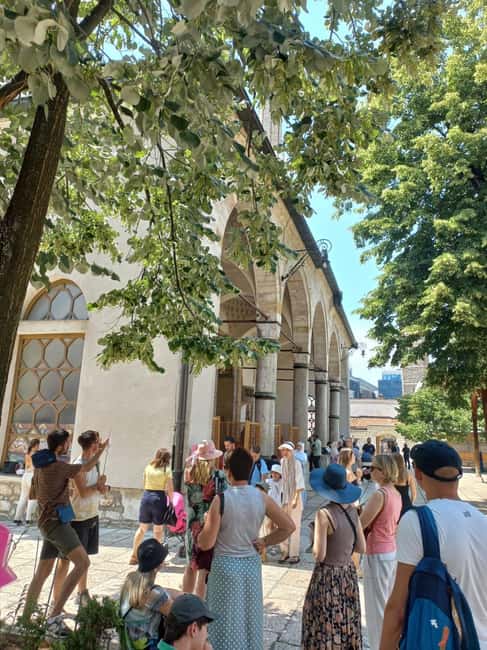
Baščaršija is the old town’s best-known quarter, and Sebilj is its famous wooden fountain. The route reaches both, but the experience is more than a quick photograph in front of a landmark. Your guide places the square, lanes, shops, mosques, and cafés within the story of Sarajevo’s Ottoman center.
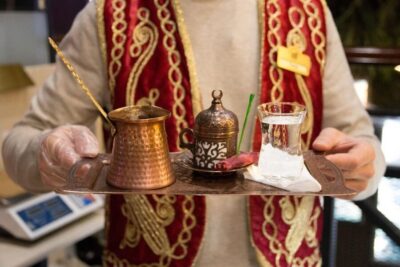
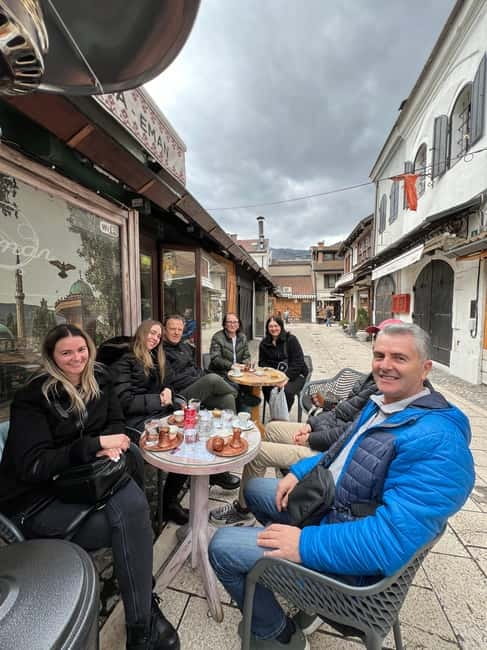
The coffee break takes place at a local café and lasts about 20 minutes. Bosnian coffee is prepared and served in a traditional way, with a small pot and accompanying cup. The ritual is part of local culture, so the stop offers a useful lesson in how people take time together, not just a caffeine break.
Traditional sweets, including baklava, are part of the food focus of this experience. The combination makes sense: strong coffee, a small sweet, and conversation are closely tied to the old town’s café culture.
I would not book this tour expecting a full meal. The coffee stop is a tasting and cultural pause, not a restaurant visit. If you need lunch, plan it before or after the walk.
The panoramic stop above the city
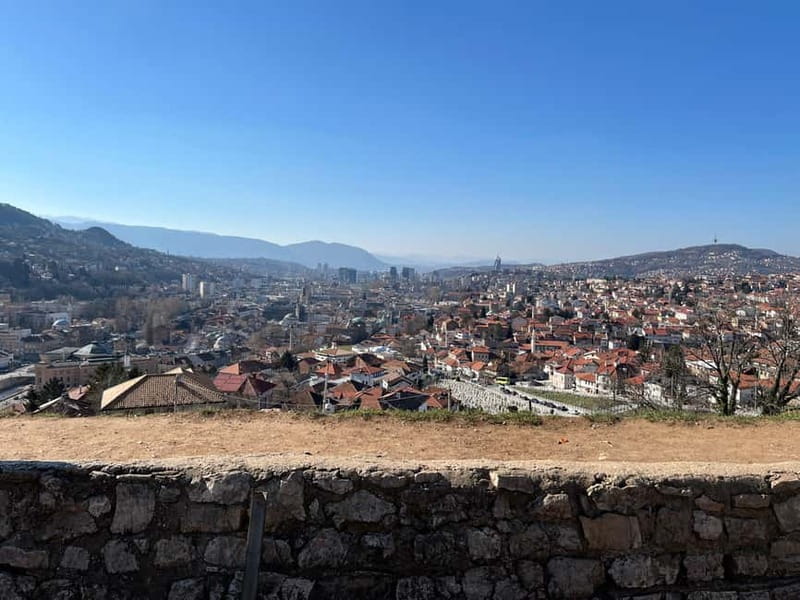
After the old town, the route includes a viewpoint with scenic views of Sarajevo. The exact viewpoint is not specified, so the walk may use a special local spot rather than a named major attraction.
This is a smart way to finish. After seeing the city at street level, you get a chance to understand its shape from above. The view helps connect the old quarter, newer districts, and surrounding hills in one glance.
The viewpoint stop lasts about 15 minutes. That is enough for photos and orientation, but not a long scenic outing. If you have limited mobility, ask about the route in advance. The tour is listed as wheelchair accessible, but the total walk, streets, and viewpoint approach may still affect comfort.
The official finish is at Sebilj. Depending on the route and guide, the panoramic stop may come shortly before returning to the old town. From Sebilj, you are well placed to continue exploring Baščaršija independently.
What the guides add to the experience
The strongest part of this walk is the human explanation. Guides may include Dijana, Daniella, or Amela. Their approach can vary, but the activity is built around a local expert who explains the city in English or one of several regional languages.
Dijana has been noted for answering questions across history, architecture, culture, customs, and food, as well as suggesting what else to see and where to go. That kind of practical advice matters because Sarajevo’s center is compact, but its stories are not.
Daniella’s role is described as friendly, helpful, and informative. Amela brings personal experience of the city’s wartime suffering while also explaining the sense of connection among Sarajevo’s different religious communities. You should not assume you will receive the same guide on every departure, but these details show the sort of local perspective the tour aims to provide.
I especially value the personal side when discussing the 1990s war. Sarajevo is not only an Ottoman and Austro-Hungarian story. A guide who lived through recent events can explain how memory, loss, and daily life still shape the city. The tone may be serious, but it gives the tour more honesty than a string of dates and decorative buildings.
Is $20 a fair price?
At $20 per person, the tour offers solid value if you want a first look at Sarajevo with context. The price includes the walking guide, Bosnian coffee, and the panoramic stop. The copper-crafting element and traditional sweets add further interest, though you should confirm exactly what is included in your booking if the sweets matter to you.
You are paying for more than transportation between sights. The route connects central landmarks that you could technically visit alone, but the guide explains why they belong together. That is the main value.
The cost makes the most sense for a first visit, a short stay, or anyone who prefers to get oriented before exploring independently. It is less useful if you have already spent several days studying Sarajevo and want long interior visits at each monument.
The tour is offered as a private group as well as a standard guided walk. A private booking costs more in many cases, but the supplied price is $20 per person for the stated experience. Check the live availability and exact booking terms before assuming a private price.
Free cancellation is available up to 24 hours before the activity, and you can reserve now and pay later. Those policies are helpful if your Sarajevo plans are still shifting.
Who should book this Sarajevo walk?
I would recommend it to first-time visitors who want the city’s main sights explained in one organized route. It also suits people who care about local food, religious history, craft traditions, and recent memory rather than sightseeing alone.
Families and older visitors may appreciate the clear structure, but the walking distance should be taken seriously. Comfortable shoes are essential, and you should be prepared for a moderate amount of walking. The activity is listed as wheelchair accessible, though it is still sensible to ask about the precise route and viewpoint before booking.
This tour is also a good fit for visitors who want practical advice from a local guide. A guide such as Dijana, Daniella, or Amela can help you decide what to see next, where to return, and how to understand the city beyond the main square.
Should you book it?
Book this experience if you want a compact introduction to Sarajevo with real local explanation, Bosnian coffee, traditional sweets, copper work, and a city view. The tour covers a lot, so the stops are generally short rather than museum-length visits.
Skip it if you want a slow, specialized architecture tour or a full food tour. For most first-time visitors, though, $20 is a sensible price for a well-rounded walk that connects Sarajevo’s faiths, empires, crafts, conflicts, and café culture in one morning.
FAQ
Where does the Sarajevo walking tour begin?
The standard meeting point is the Eternal Flame monument in Sarajevo. The regular tour begins at 10 a.m. Private bookings can include pickup at your hotel or another agreed address.
How long does the tour last?
The activity lasts between 150 minutes and 3 hours. The exact duration can depend on the starting time, pace, and tour arrangement.
What is included in the price?
The experience includes a guided walking tour, an English-speaking local-expert guide, Bosnian coffee, and a panoramic view of Sarajevo. The activity also includes a visit to the copper-crafting area and the chance to try the craft.
Which languages are available?
Guides may lead the tour in Croatian, English, Serbian, Serbo-Croatian, or Bosnian. English is specifically included in the standard tour information.
Is the tour wheelchair accessible?
The activity is listed as wheelchair accessible. Since it involves a moderate amount of walking through streets and includes a viewpoint, ask about the exact route when booking if accessibility is important for you.
What should I wear for the walk?
Wear comfortable shoes and check the weather forecast before setting out. You should dress appropriately for outdoor walking and be ready for a moderate amount of time on foot.
Just listed in the world
- Vietnamese Coffee 101 Workshop★ 5.0 · 11 reviews
- Vietnamese Coffee Making Class in Hoi An★ 5.0 · 4 reviews
- Yerevan: Private Coffee Tour with 2 Café Stops★ 5.0 · 2 reviews
- Turkish Coffee and Traditional Turkish Dessert Cooking★ 4.6 · 8 reviews
- Ubud: Waterfall, Holy Water Temple,Swing&coffee plantation★ 5.0 · 9 reviews
- Vancouver: Street Art & Craft Coffee Walking Tour w/ Tasting★ 4.8 · 11 reviews
- The Colors of Coffee in the Farms of Coatepec★ 5.0 · 3 reviews
- Vienna: Guided Viennese Coffee-House Tour★ 5.0 · 2 reviews
Coffee Tours, compared.
Hanoi Coffee Experience: 6 Brews, 9 Recipes & 3 Liquor Tastings
Read our review →
Coffee Tour with Transport, Snacks and Tastings
Read our review →
Turkish Coffee Making and Fortune Telling Workshop
Read our review →
Hanoi Coffee Workshop: Taste Salt, Coconut and Egg Coffee
Read our review →
Vienna for Food Lovers: Cafés, Markets & Austrian Cuisine
Read our review →
Salt Coffee Workshop Awake Your Senses With 6 Brews
Read our review →